TB.One > Import & Export > Master Data Import via TB.Cat/XML > TB.Cat - XML Structure > TBCATALOG > PRODUCTDATA > PRODUCT > P_CATEGORIES
P_CATEGORIES
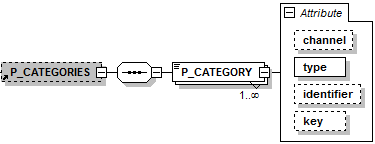
NODE |
REQUIRED |
DESCRIPTION |
|
|---|---|---|---|
P_CATEGORIES |
N |
XML |
Product categories |
P_CATEGORY |
Y |
CHAR(200) |
Product category |
P_CATEGORY[channel] |
N |
CHAR(12) |
Channel sign (only for primary or secondary channel category) |
P_CATEGORY[type] |
Y |
ENUM |
Type of the product category. Possible values are: |
P_CATEGORY[identifier] |
N |
ENUM |
Indicator for referencing (key or name) |
P_CATEGORY[key] |
N |
CHAR(50) |
Value stored in the identifier assignment statement |
EXAMPLE: For illustration, the examples below contain clusters and internal categories. However, we recommend only using one of these two features.
New creation (cluster/internal category)
|
For further information, see also:
▪Master data import via XML - overview
▪XML structure overview - TB.Cat 1.4
▪XML structure overview - TB.Cat 1.2/1.3
▪Examples: XML for TB.Cat 1.4 or TB.Cat 1.2/1.3